“If we all could understand that we are connected by a common consciousness, this is what could solve the problems of the world.” ~Joan Diver
When Spirit Calls is the culmination of over two decades’ worth of work, as she started it back in the early 1990s, initially as a project for writing out six or eight spiritual experiences. Her journey began with a bad back which began back in the 1970s and some unsuccessful operations, which made her look for alternative methods of healing. She began having some unusual experiences after one particular surgery, and after asking a psychic what was going on, she was told that she was in the process of balancing her various energies. A visit to a New Mexico healer placed her right on the path she is presently on, and along the way she made a commitment, visiting the Great Pyramid of Giza, to “go forth and do it,” which she would later discover was to write her book. It was after that when she received, and accepted, various invitations to travel to places where she experienced unusual events as well as a positive shift in her foundation work, which she was still then into.
Some of the unusual experiences Joan experienced was getting greatly moved when, in China, she visited a destroyed temple as well as when she watched a group of prisoners who were being paraded through town to their execution. She also had some spiritual experiences when visiting Israel, with the most profound being one where she felt led to walk to the Church of the Holy Sepulchre, where she felt guided there and back, as she still doesn’t know the path to and from there.
Joan notes that going on a journey like she did would both heal oneself as well as bring up fears that need to be faced and resolved, and some of the issues she needed to resolve were her own self-doubts. The most serious concern she had during her journey was her back, as it tricked out several times during her journey. She looks at these events as gifts, as she finds herself in a better place once she had resolved these. Moving forward is her primary concern, and she knows she’s on the right path when she feels “a ball of anxiety.”
For Joan, the highs are when she reaches a place where she feels a deep connection to the peace and love within herself as well as within others, as well as when she can transform other people’s lives and emotions. For her, a high feels like a great inner peace, and awareness of the connection between and among all, as well as being able to see the signs in one’s life which guide one onwards - something which can be fairly scary, but following which delivers a “great gift.”
Joan’s husband, Colin, was trained logically, so initially he felt threatened and skeptical about the journey she took, as he was afraid Joan would leave him. His mind changed as he watched Joan transform and felt that he was getting left behind, and so began traveling his own journey, with the major turning point being meeting someone he had encountered in a past life. At present, he describes himself as a “stowaway” on Joan’s journey, and the two are as close as they can ever be.
Where When Spirit Calls is concerned, Joan notes that it is a “page turner” and can be read as much as a memoir as well as a way by which a reader can see a reflection of his or her own life, as the experiences speak to a universal form. To those who are questing for something other than what they have, Joan recommends that they take the time to be still, in whatever way works for them, in a way that enables one to step out of their life for a short period of time. She also recommends that people seek help from others who can help them gain a new perspective on their own lives. It is her hope that When Spirit Calls inspires people to see their own fears and hurts, then seek healing so they can find peace for themselves, as well as to love and to forgive and to be open to the possibilities of there being a guiding spirit and that we are all connected to a common consciousness.
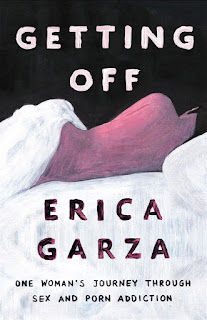
PLAY THE VIDEO AND LISTEN TO THE INTERVIEW WITH ERICA HERSELF. “Shame was the driving force in the way my addiction manifested.” ~Erica Garza
Erica decided to write Getting Off for several reasons, one of which was her using writing as a way to deal with difficult emotions and gain perspective on her life. It was because of this that she felt most at home with the Hoffman process (which is a seven-day retreat where writing is one of the methods involved) to help her come to terms with her own sexual addiction, and the seed of the book was an essay she wrote on the topic. Writing the essay was challenging for her, and after she posted it online, she received a lot of emails from people who felt isolated, alone and ashamed with their own sexual addictions. The responses encouraged her to write more and the result was book she eventually authored.
Erica grew up in a Catholic environment, and her family environment was one of love and support. She began the road to sex addiction when, at the age of twelve, she was diagnosed with scoliosis and needed to wear a back brace for two years. She accordingly felt very self-conscious, insecure and anxious about herself and her body, and had, by then, began masturbating and exploring pornography. She then began using masturbation and pornography as a way to get get a break from the insecure and scary thoughts and feelings that were her normal experience, noting that, when she was focused on achieving orgasm, that was the only thing she would think about.
Sex became an escapist crutch for Erica to lean on as she grew older, and her leaning on that crutch was enhanced by the growing presence and ease of availability of pornography on the Internet. Having sex with men also added to this crutch, and even then Erica used sex to help hide her emotions and self away from others, as she found connection and friendship to be challenging; and this made her lonely. This desire to shield her emotions was also what led her to sabotaging any relationships where she felt she was getting emotionally close to a man, so she could maintain her emotional distance.
Erica points out that women, just like men, can be sex addicts and watch and view the same kind of pornographic material that men look at, and a lot of her emails bear this out. Where conversation is concerned, however, women don’t speak publicly about this issue, which only adds to the layer of shame which sexually addicted women already feel. She points out that being told by others that something which one is experiencing “doesn’t exist” results in that person shutting down, and that this resulting isolation, silence and shame only fuels addictions even more, whereas bringing these issues out in a safe and supportive space results in healing.
Erica notes how sex addiction, and the drivers for this, vary from person to person, and the best indicator is to ask oneself the questions:
Am I using sex as a way to escape from problems in my life?
Am I using sex in a destructive way?
Am I putting myself into situations where I feel I’m not in control?
Erica also notes that, in her case, the kind of porn she watched was the extreme kind where she felt bad, disgusted and ashamed. Where relationships with men were concerned, she gravitated towards those where she felt used and unkindly treated, which she notes reflected the way she treated others. Somewhat ironically, Erica admits that she needed to feel turned off, bad and abused in order to feel the adrenaline rush of a sexual experience.
Isolation was a big result of her sex addiction on herself, which fed into her feelings of shame, worthlessness and self-loathing. Erica admits that the people around her, family included, most likely felt neglected, as she felt that they weren’t worth her time. She notes that other people can most relate to her experience of being lost and stuck in the kind of negative feelings she experienced.
Erica did not hit “rock bottom,” which is a common wake-up call for those addicted to drugs and alcohol, as she gradually realized her sexual addiction over time. That said, she finally realized what was going on after she deliberately sabotaged a relationship and also realized that she would be turning thirty soon, and she then decided to do things differently, which led her to her trip to Bali, where she began figuring things out.
Breaking her sexual addiction required Erica to break the patterns which enabled these, and one of the things which helped her do so was to create boundaries where she could still be sexually exploratory in a way that didn’t hurt those whom she loved. For her, moving on from becoming a sex addict was all about finding moderation and balance, as well as dealing with the feelings of shame and unworthiness that drove her sexual addiction in the first place. Telling the truth, for Erica, is the most powerful way to come to terms with her sexual addiction.
Erica notes that pornography isn’t the cause of sex addiction, noting that, if pornography didn’t exist, people would go to some other source of titillation, like strip clubs and peep shows. She also notes that, even if pornography didn’t exist, she would still have felt the same feelings and desires that had led her to becoming a sex addict.
To those in a similar situation that she was in, Erica recommends that they find someone to talk to, one who can listen from a space of non-judgement. Erica also strongly recommends that they go to a Twelve Steps meeting, where they can meet with like-minded people and talk about their concerns in a safe environment. She also notes that, for some people, a single method, e.g., just Twelve Steps or just yoga or just meditation, might not work, and that a combination of such methods may be needed to reclaim balance in their lives.
“The slower you go, the faster you get there.” ~Lisa Danylchuk on Embodied Healing
Lisa is both a licensed marriage and family therapist and a registered and certified yoga teacher who has worked with various people, such as those in low-income areas, on issues related to stress. She wrote the book so she could reach those whom she couldn’t reach directly. It is primarily intended for those people who deal with those suffering from trauma, giving a foundation of treatment and yoga philosophy, as these presently exist, to help those suffering from trauma. There was no single incident that made Lisa think about writing the book; rather, it was a long-time process that arose from her yearning to write a book.
Lisa noted that stress is not necessarily a bad thing, as a certain degree of such is necessary in our daily life and is good for us. Extreme stress and trauma, however, impacts the entire human system - mind, body, energy, spirit - particularly the nervous system, which gets either hyper-aroused (which results in such emotions as anxiety and anger) or hypo-aroused (a parasympathetic reaction which results in such emotions as depression and dissociation, or numbness and “checking out”). She notes that traumas can spring from physical threats (such as physical violence) as well as emotional threats (such as bullying), and that different people respond differently from the same situation - depending on personality, how they were raised and other factors, with one person suffering long-term trauma from one situation while another would just shrug it off.
Lisa stresses that such reactions are a normal human reaction to an abnormal environment or situation, such as physical abuse in the home and chronic violence next door, and the treatment depends on how the person so traumatized reacts, rather than on the situation itself. A proper treatment thus needs to be tailored to the individual concerned, and knowing what questions to ask and what choices to make are thus very important.
Lisa noted that different populations have different percentages of people who suffer from trauma, and she remarked that, while trauma has been a recognized condition ever since it was first labeled as “shell shock” in World War I, the traditional therapies, which included electroshock therapies, weren’t based on a full understanding of trauma, and were thus crude. Lisa noted that, even in the past twenty years, trauma treatment has progressed a great deal, but that there also is more to learn. She also remarked that she has a wide variety of methods she can use and chooses the particular treatment for a particular patient, and that shame is still a major obstacle for people who are seeking help for trauma, which makes a good relationship between the patient and the therapist vital to the process itself.
To someone who is suffering from stress, Lisa would first ask how they want to feel, and that, as instilling hope is very important, she would then tell them that it is possible to heal and recover from trauma, that there is help available out there and that they should get help. Lisa notes that those who have healed from their traumas are happy to share their experience, and that trauma is not about the person involved, since bad things happen to anyone.
Lisa wants to write a book on healing in general in the future.
“As average people, we could tap into this incredible shamanic world.”~Dr. Susan Allison
Photo of Dr. Allison from her website.
Susan had always been seeing spiritual beings since childhood, when she grew up in an orchard, where she communicated with angels, elements and animals. Her mother viewed such stories as those of childhood fantasies that had to be humored, and even as a child, Susan remarked that she had always had intense energy in her hands which she could use to heal animals and her parents. While Susan maintained her connection to the Spiritual Realm throughout her life, such as using that energy to heal through Reiki practices and in her work as a transpersonal psychologist, she expanded her exploration into shamanic practices after a workshop in 1993, which was led by someone who was trained by Michael Harner, founder of the Foundation for Shamanic Studies and author of The Way of the Shaman: A Guide to Power and Healing and Cave and Cosmos: Shamanic Encounters with Another Reality. Since then, she has been able to easily access and travel into the shamanic world.
Susan points out that the title “shaman” is bestowed by one’s tribe, so those who haven’t been granted such a title call themselves shamanic practitioners. As a shamanic practitioner, Susan communicates closely with Nature, which is very important in shamanic practice. Susan also notes that, prior to journeying into the shamanic world, one must set one’s intention of what one wishes to accomplish or experience.
This recording is available from Dr. Allison's site.
Although Susan admits that the book had been brewing inside her all her life, the catalyst was her husband’s six-year bout with laryngeal cancer, during which time she became even more involved in traveling to the shamanic world, to alternate dimensions of reality which, according to her, have been mapped by shamans for the past sixty thousand years, to get information on how to help and heal her husband’s illness. Her husband eventually passed away, but the experience, as well as her subsequent journeys into the shamanic world, where she met her husband in spirit, served to prod her into writing the book where she describes the different spirit worlds revealed in a relaxed and deep state of consciousness induced by drumming.
The Middle World, according to Susan, is the nexus from where one goes to the Lower or the Upper World, and is called, in Hawaiian shamanism, the “Sacred Garden.” It’s very much like a dream state whose appearance differs from person to person. A traveler to the Middle World can invite beings that love him or her while here, including spirit allies and teachers, as well as beings who show up and surprise the traveler, all of whom serve to enrich one’s present, existing life on Earth. The Middle World is also a place of refuge and renewal, where our spirits go to after our bodies die.
The Lower World is accessed from some kind of opening from the Middle World, such as a cave or a tree hollow, and is a place of ancient, pristine, primeval nature, where wise animal spirits abound which can guide and help the traveler and which communicate mentally. Susan remarks that the Lower World is a place where one can release personality and character traits that don’t serve one any longer, such as being judgmental, resentful or angry. It is also a place where one can also assume an animal form and then experience the spiritual power associated with that animal.
The Upper World is initially accessed with the aid of spirit animal guides from the Lower World, and eventually, travel up to this world is done according to one’s own reality; Susan, for example, journeys by going to the top of the tree in her Middle World and then asking for a being to carry her up to the Upper World, while another of her colleagues uses an elevator. A traveler has to pass through a sort of veil-like mist or membrane, according to Susan, and within the Upper World is a library where one can access one’s past lives and invite such beings as one’s family members who have already passed on and divine teachers.
Susan notes that each person’s world is different, and it is because of these that she cautions that the worlds that are described in books detailing travels to the spiritual realm may not be the ones that a traveler will experience. Susan also remarks that she has encountered beings from other traditions, such as Rama from Indian belief, and that even people who don’t believe can so travel to the shamanic world, and beings that love the traveler will show up and share things that the traveler needs. She notes that time isn’t linear in the Shamanic World, so the spirits of the beings can be everywhere at the same time, and that researching on the spirits after meeting with them can produce surprising results, such as with the research she did on one of her ancestors who communicated with her.
Susan would suggest to people to suspend their disbelief, and remarks that those who don’t believe in the shamanic world often have a scientific outlook. To them, she suggests studying quantum physics, which tells that everything is energy, and to think in terms of energy. Susan notes that things will happen in the Spirit Realm that one could not make up, such as her meeting Rama or Lao Tzu, whom she didn’t even knew about until she met them. Susan emphasizes that she has written a workbook for readers of her book and hopes that it will dispel the fear of death that anyone has, and help support the belief that one can visit their departed loved ones in the Spirit World at anytime he or she wishes to do so.