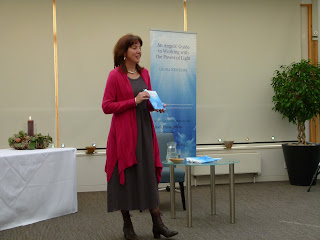
“As average people, we could tap into this incredible shamanic world.”~Dr. Susan Allison
Photo of Dr. Allison from her website.
Susan had always been seeing spiritual beings since childhood, when she grew up in an orchard, where she communicated with angels, elements and animals. Her mother viewed such stories as those of childhood fantasies that had to be humored, and even as a child, Susan remarked that she had always had intense energy in her hands which she could use to heal animals and her parents. While Susan maintained her connection to the Spiritual Realm throughout her life, such as using that energy to heal through Reiki practices and in her work as a transpersonal psychologist, she expanded her exploration into shamanic practices after a workshop in 1993, which was led by someone who was trained by Michael Harner, founder of the Foundation for Shamanic Studies and author of The Way of the Shaman: A Guide to Power and Healing and Cave and Cosmos: Shamanic Encounters with Another Reality. Since then, she has been able to easily access and travel into the shamanic world.
Susan points out that the title “shaman” is bestowed by one’s tribe, so those who haven’t been granted such a title call themselves shamanic practitioners. As a shamanic practitioner, Susan communicates closely with Nature, which is very important in shamanic practice. Susan also notes that, prior to journeying into the shamanic world, one must set one’s intention of what one wishes to accomplish or experience.
This recording is available from Dr. Allison's site.
Although Susan admits that the book had been brewing inside her all her life, the catalyst was her husband’s six-year bout with laryngeal cancer, during which time she became even more involved in traveling to the shamanic world, to alternate dimensions of reality which, according to her, have been mapped by shamans for the past sixty thousand years, to get information on how to help and heal her husband’s illness. Her husband eventually passed away, but the experience, as well as her subsequent journeys into the shamanic world, where she met her husband in spirit, served to prod her into writing the book where she describes the different spirit worlds revealed in a relaxed and deep state of consciousness induced by drumming.
The Middle World, according to Susan, is the nexus from where one goes to the Lower or the Upper World, and is called, in Hawaiian shamanism, the “Sacred Garden.” It’s very much like a dream state whose appearance differs from person to person. A traveler to the Middle World can invite beings that love him or her while here, including spirit allies and teachers, as well as beings who show up and surprise the traveler, all of whom serve to enrich one’s present, existing life on Earth. The Middle World is also a place of refuge and renewal, where our spirits go to after our bodies die.
The Lower World is accessed from some kind of opening from the Middle World, such as a cave or a tree hollow, and is a place of ancient, pristine, primeval nature, where wise animal spirits abound which can guide and help the traveler and which communicate mentally. Susan remarks that the Lower World is a place where one can release personality and character traits that don’t serve one any longer, such as being judgmental, resentful or angry. It is also a place where one can also assume an animal form and then experience the spiritual power associated with that animal.
The Upper World is initially accessed with the aid of spirit animal guides from the Lower World, and eventually, travel up to this world is done according to one’s own reality; Susan, for example, journeys by going to the top of the tree in her Middle World and then asking for a being to carry her up to the Upper World, while another of her colleagues uses an elevator. A traveler has to pass through a sort of veil-like mist or membrane, according to Susan, and within the Upper World is a library where one can access one’s past lives and invite such beings as one’s family members who have already passed on and divine teachers.
Susan notes that each person’s world is different, and it is because of these that she cautions that the worlds that are described in books detailing travels to the spiritual realm may not be the ones that a traveler will experience. Susan also remarks that she has encountered beings from other traditions, such as Rama from Indian belief, and that even people who don’t believe can so travel to the shamanic world, and beings that love the traveler will show up and share things that the traveler needs. She notes that time isn’t linear in the Shamanic World, so the spirits of the beings can be everywhere at the same time, and that researching on the spirits after meeting with them can produce surprising results, such as with the research she did on one of her ancestors who communicated with her.
Susan would suggest to people to suspend their disbelief, and remarks that those who don’t believe in the shamanic world often have a scientific outlook. To them, she suggests studying quantum physics, which tells that everything is energy, and to think in terms of energy. Susan notes that things will happen in the Spirit Realm that one could not make up, such as her meeting Rama or Lao Tzu, whom she didn’t even knew about until she met them. Susan emphasizes that she has written a workbook for readers of her book and hopes that it will dispel the fear of death that anyone has, and help support the belief that one can visit their departed loved ones in the Spirit World at anytime he or she wishes to do so.
“It is important for us to ASK the Angels for help as they have no free will to intervene in our lives (unless exceptional circumstances) without being invited. They need us to ask and we must not feel greedy or selfish to ask.”~Laura Newbury
Laura lives in Stirling, Scotland and grew up in the Quaker faith, where the practice is for a group of people to gather in a circle and for anyone within who feels inspired to take charge of the meeting. Angels weren’t particularly emphasized when Laura was growing up, and she had believed that angels communicate only with mystics and the like, but one day, when Laura was out with her four-year-old twin sons, one of them got lost while they were in a park, and Laura then began to frantically look for him. It was then that she called out to the angels to surround and protect her missing son, and she heard a reply, like a clear echo, that told her “twenty minutes,” and she just knew that everything would be fine by then. Laura then returned to her friend’s house, at the latter’s suggestion, and while there, she experienced a connection between herself and her then-lost son as well as a feeling of peace, despite her frantic feeling. As expected, after 20 minutes, her friend returned to the house with her missing son, and told her that, when the boy had been found, there were several young children standing around him, as if protecting him.
Laura didn’t think much about that incident until, eight years later, the same son got ill, which came at a time when she was experiencing terrible headaches, and one night, while she was feeling tired and in despair, she was “inspired” to write a letter to the angels. She received a reply in the form of a voice that said all would be well, and when Laura asked who was speaking the voice said that he was her son’s guardian angel, a red angel. Laura began writing “thank you” letters to the angels after that, which she placed in various locations around her house, and as she wrote those letters, she realized she was receiving replies from the angels, and one of the messages was, “Write a book… write a book.”
Schutzengel by Bernhard Plockhorst
According to Laura, the word “angel” comes from the Greek word aggelos, which means “messenger.” Laura noted that angels are a part of just about every faith on Earth, and while angels do act as messengers, they also have other functions, such as protection and healing. The angels themselves have told Laura that they are manifestations, or the loving arms, of God, and that they carry out God’s will, abiding in the dimensions between the physical realm, which is where humans live, and the heavenly realm. They can appear as a physical being, but not necessarily in the stereotypical form of them being winged and human-like. She gave an example where, before she had all her extensive angelic experiences, she saw a large figure at the top of a mountain bathed in light, a being which had light strands radiating out from it, but she didn’t recognize it as an angel until much later.
Colors have a huge significance where angels are concerned, as these relate to the vibrations associated with the colors, and which seem to be associated with the various chakras of the human bodies. Red, for example, is the color of the archangel Metatron (an archangel in Judaism, known as the Recording Angel or the Chancellor of Heaven - Wikipedia), who guarded her son and who brought her to her present path of angelic communication. Laura explained that Metatron is the archangel who looks after gifted children and is also the archangel of sacred maths and geometries, which, given her sons’ penchant for mathematics, seems to make sense. Deep emerald green with a pinkish hue at the edge of the green is the color of the archangel Raphael, who is the archangel related to healing. Where chakras are concerned, the color green is associated with the heart, and given that most healing takes place in the heart it follows that Raphael also be associated with the color green.
Abraham and the Three Angels by Ludovico Carracci
Laura communicates with the angels visually, such as when she sees colors associated with a person’s angel, but she also hears voices and words that she describes as “loud thoughts” which she knows are from angels because they are different from how she would normally think or how she would normally write. When she wrote the book, she saw the words appear in front of her, as if on a screen. She said the angels gave the book’s contents word by word and phrase by phrase, so that she never did know the entire sentence she was writing before she actually finished them.
Laura notes that finding a quiet place is very important when enabling angelic communication. Quieting one’s mind and taking four big, deep breaths, breathing in through the nose and then exhaling through the mouth, creates a physiological state that’s receptive to talking to angels. That said, the angels can still send people messages even in the loudest of environments, if necessary. Being in nature also helps, as Laura states that the angels have told her that all life is sacred and appreciating the beauty of Nature and of the Earth creates a state of gratitude wherein the connection is made that much easier.
Laura notes that a lot of people are seeking spiritual guidance in today’s troubled times, and that the messages of angels are full of love and guidance on how to send light out into the world. She notes that the consistent message from the angels is that, if people can get in tune and follow their gifts, they can send out peace which radiates and helps others. It is the perpetuation of this that will create peace throughout the world.
They say the universe is in support of life and founded on love. Fear and negative happenings come from misalignment in some way. It happens when thoughts turn from love to fear. Events occur as a result and things get worse until someone comes along to change the pattern. This creates a knock-on effect and other effects come back into their natural alignment. Your prayers go out, and even if you do not know exactly where they will go, they will arrive and help change events. You’re all connected and your consciousness is connected with all that is happening in your world. Prayers, therefore, affect everything, and the world is saved, heart by heart and soul by soul, and the power comes from the individual and the power is love. Love is the only power and love does not coerce.
It was while she was writing the book that the headaches that Laura had been experiencing for so long finally disappeared, and this she attributes to her connection with the angels. After that, she was given methods on how to heal pain and was told to go out and teach these, which is the new path that she is now presently on. Laura remarks that she now has the strength and courage to walk this path due to her healing and angelic support. Laura notes that it doesn’t matter if you believe in angels or not, but if you is true to yourself and follow one’s own gifts and heart, and also be inspired by that which makes one feel joy and happiness, you will radiate a lot of the universal energy and will help others as well.
Laura is in the process of writing a book in conjunction with the angels of the Earth, which she says is about the environment and how we humans can cooperate with the spiritual guides of the environment to save our planet. At present, the rough title is A Devas’ Guide to Earth Healing: Messages for Our Times.
A special message from angels to people as delivered to Laura:
"We love you all and take great delight in communicating on things both great and apparently small. But nothing is too small for us angels and we urge you to keep asking, for our power to help is unlimited and you are not being greedy or taking another person's share by asking us. This is limited human thinking. As long as you keep a loving heart and have the good of all the world as your aspiration, then nothing can be too big or too small to ask."~Angels' Message to People
“I was forced to, compelled, to come up with my own theory on this because no one had written about it.”~Tony Fairfax, on writing The Presidential Trend
Tony started out as an electrical engineer who worked for a manufacturing company and an engineering consulting firm, and then became an entrepreneur, starting a business with a few other people during a recession period in the US economy. After the business closed down, Tony, as a consultant, connected with a local university and was involved with a redistricting project, which is one wherein political boundaries are redrawn throughout the United States. This began his career as a mapping and demographic consultant, which is what he is doing up until today as an expert whose testimony on demographics is recognized in federal courts.
Tony’s interest in the presidential trend he writes about began when he read a census report that had a graph that led to his investigating the topic. The major trend he talks about is the increasingly linear trend of popular votes for the Democratic presidential candidate from 1972 to 2000, despite the voter turnout percentage differing from election to election, while during that period, the popular votes for the Republicans and independents combined fluctuated. Tony remarks that, after investigation, the trend actually began in 1968, when the electorate "fractured" between Democrats and non-Democrats, and that the trend makes sense when core base voters - voters who would vote Democrat, Republican or for their candidate, no matter what - are considered. This increasing linear trend, according to Tony, is due to the increasing population of Democratic core base voters and generational perpetuation of loyalty to the Democratic party.
In 1968, a certain section of Democratic voters peeled away from voting for a Democratic president, and this section never came back to vote for a Democratic candidate except during 1976, which is a year that doesn’t fit the 1972 - 2000 trend.
Where the Republicans and independents are concerned, a trend doesn’t exist but a mirroring type of voting pattern does. Mirroring occurs when, say, a hundred people vote for two candidates, and if all of them vote, and if one person gets 70 votes, the other person will get 30 votes. This mirroring comes from the non-Democratic party voters and means that, if a Republican candidate gets a lot of votes, the independent candidate will get fewer votes, and vice versa. The only time this mirroring didn’t happen was in the 1992 election, due to then-candidate Ross Perot being unable to make inroads into the Republican core base voters.
Tony notes that the linear trend might have stopped at 2000, but he says that there is still a trend in the form of the Democratic popular vote percentage, which deviates only around 2.6% from the trend line. The trends are more visible at the national level, and while these exist at the state and local levels, these aren’t as visible because people change locations, from city to city or from state to state, throughout the year. The Democrats, because they have most of the so-called minority vote, have an advantage in the coming decades because of the increasing percentage of the minority population in the United States.
To a Republican candidate, Tony would advise him or her to attract voters from the Democratic electorate, particularly given that the Democratic electorate is larger than the non-Democratic electorate. To a Democratic candidate, Tony would advise him to go after progressive policy issues.
The journey Tony took while writing the book was one wherein his original hypothesis, that the trend was disrupted by the war that took place in 2000, was proven mistaken and made him focus on the role of demographics and base voters where the trend is concerned. He also notes that the journey is still ongoing, which could be the potential topic for another book. He had actually came up with a companion book to The Presidential Trend which is a condensed version for individuals to be able to grasp all of the features of the trend in one or two reading sessions.
Coach Mark Speaks talks to Alexander “The Engineer” Lim, host of AuthorStory by alvinwriter.com about his book, Repeat After Me.
“Learning is a lifelong event, and you gotta always, constantly be learning.”~Coach Mark Speaks
Belief Coach Mark Speaks
Coach Mark was born in Jamaica and came to the United States while young. He might not have been an avid book reader in his childhood, but even at a young age he had an entrepreneurial mindset. By his own admission, he worked on a number of business endeavors in college, and before graduating, he and a roommate set up a nightclub, which might have had a lot of potential but became a serious financial drain for them. The nightclub stint, however, gave him experience in design, which he turned into a viable multi-million dollar business
Coach Mark admits that his success wouldn’t have happened had he not looked around and seen people who might not have had products as good as his but who were apparently doing better, and then told himself that, if they could do it, so could he. Since then, he had studied success and successful people, and credits being an avid learner for ten years as being part of his success, noting that he has well over a thousand paper, audio, and ebooks in his library. He notes that age and background aren’t barriers to achieving success, citing such examples as Grandma Moses, who achieved success in her seventies, and Whatsapp founder Jan Koum, who was an immigrant who was financially strapped when he and his family arrived in the United States.
Once he got enough passive income to live on, Coach Mark then focused on helping others become successful. His goal is to enable people to believe in themselves, focusing on particular aspects of people’s lives that they want to achieve success in. Repeat After Me is the result of a years-long desire to write a book, but it wasn’t until he thought of writing about success that he actually did so. Coach Mark wrote and designed Repeat After Me to be deliberately easy to read, not intimidating, and easy for people to digest, particularly since he noted that a lot of people don’t pick up book after leaving high school or college.
Coach Mark included other reference books in the chapters on purpose, rather than place these all in the back of the book, as he noted that most people don’t read the material in those parts of the book, to make it easy for people to refer to those references. He sees positive affirmations as being very important to a person achieving his goals, as these reprogram a person’s mind to lean towards success. Coach Mark noted that people, due to the environment and the people around them, engage in negative affirmations, which are detrimental to their succeeding, as they are flooded with negative affirmations throughout their lives, usually because people impose their own negative beliefs on others. He believes that the only way to get answers, and thus results, is by asking questions, hence the importance of questioning oneself.
Coach Mark would love for his book to be read all over the world to help people develop themselves, as an entry-level book to success, and he wants to touch lives all over the world. He loves to learn, remarking that it is a measure of how successful his life is that he finds it difficult to name something he doesn’t like to do, and would like to travel to Africa and South America.
“When I get started on my book, I don’t wanna stop.” ~Lynn Jackson
Lynn used to run a rescue farm for horses and other animals, including a manatee and an elephant. She’d lived on that farm for the past seventeen years and along with her husband and son, have contributed much to the welfare of abused animals. At the time of her interview with AuthorStory, she and her family were moving to a new home.
Lynn admits she hates to read, particularly since she says she doesn’t want to be influenced by other authors, although she admits to being influenced by the black-and-white, classic horror movies she saw as a child which never quite scared her. Lynn loves artwork apart from writing and she admits that, if she could write twenty-four hours a day, she would do just that.
She started out by writing children’s poetry and has moved on to other genres from there. Her goal in life is to write a hundred stories and she has so far written about a dozen with ten more stories in the pipeline as of this writing.
Lynn remarks that living on a farm and dealing and interacting with the animals there can bring up a wide variety of emotions that she can put into her book, and that some of the names for the animals in her stories are actual names of animals on the farm. Of all the characters she had written out, Lynn found that Jason of A Midnight Howl, really appealed to her, so much so that her hands were shaking when she was writing out a particularly intense scene. She admits to having “fallen in love” with her creation due to his being a character who was funny and plucky and one who also had to fight for what he got.
Lynn created The House Dorstanton series of books in which Child of Darkness and Lost in Darkness are the first books of a big story where vampires and all sorts of fey creatures, such as elvens and trolls, live side-by-side with mortal human beings like knights and wizards. She also doesn’t focus wholly on the main characters but also on other events, in other areas, and lands, particularly since she wants to keep things interesting and unpredictable for the reader.
The House Dorstanton series actually started around the mid 1990s, but it took a long time for her to get the series done because she would write other books while she was also working on the vampire stories, saying that there were times that a book “tapped her on the shoulder” and demanded that she write it.
The research that Lynn did for the series was based on the need for her to bring the world in the books to life, such as weapons and the way of life in the kind of era where the story would take place or is inspired by. She keeps notes on the world of The House Dorstanton Series because of the many characters and places involved.
She admits that she had experienced paranormal activity throughout her life and she once lived on a farm that has the reputation of being one of the most haunted in America, although these experiences have yet to reflect in one of her books. If and when she writes a book on ghosts, these supernatural experiences would definitely find a place in the story and characters. She doesn’t have any particular person in mind when she writes her books, but she does keep their age level (adult, young adult, or children) in mind.
One of Lynn’s future stories is about Pit bull fighting, with which she hopes can make people realize the evils of Pit bull fighting. She would like to go one of these days to Las Vegas for the excitement, as well as to Africa to see the animals there, especially the elephants.
Marivi Soliven talks to Alexander “The Engineer” Lim, host of AuthorStory by alvinwriter.com about her book, The Mango Bride.
"Filipinos are a lot more than pansit, lumpia, and Manny Paquiao."~Marivi Soliven
Marivi was formerly an instructor of English at the University of the Philippines, and she moved to the United States in her thirties after she got married and as such her sense of identity as a Filipino was already fully-formed. She remarked that she had to change her way of thinking when she got to the United States, since her first job as a caregiver and personal assistant to a disabled professor was disparate from her previous work as an educator and her later jobs as an interpreter and an advocate of anti-domestic violence.
Marivi was aware that becoming an immigrant is a long process, and she also mentioned that the sense of dislocation, of being removed from one’s roots, was part of her experience as an immigrant, and is most likely the same kind of experience that other immigrants go through.
Marivi wrote the book because she simply wanted to tell the story of Filipino immigrants in the United States, rather than to appeal to any particular audience, but she notes that it would most likely appeal to those who have moved to an unfamiliar country from the place they grew up in. She chose a mango for the title because that fruit is synonymous with the Philippines. She noted that she wanted to give an alternative view of immigrants, in general, other than the commonly-held image of foreigner who is seeking a better life as they can’t survive on what they would earn in their home country. She notes that some Filipinos, herself included, who emigrated didn’t know how to operate a washing machine (like maybe what's in most walk-in DIY wash services) when they first arrived in the United States, because in the Philippines, such chores are handled by the household help, or at least in middle- and upper-class families.
Some of her experiences went into the book and the places mentioned are likewise drawn from her own life. Her main character, Beverly, is “at least 95%” based on real life. For the character of Amparo, Marivi drew on her memories of her own mother and her aunt. In writing the book, she needed to do some research on police procedures and Google Maps, and asked friends in Manila to take pictures of places mentioned in the book.
Marivi admits that she had read the works of a lot of authors, such as Hemingway and Karen Christence Dinesen (aka Isak Dinesen) and some of them definitely influenced her writing style, particularly Jhumpa Lahiri when it came to how to present Tagalog conversations in her book, and as she has occasionally watched Filipino soap operas, she remarked that the overall frame of her story is based on similar contexts.
Marivi notes that food is a metaphor for love, and that she deliberately wanted to highlight the Filipinos’ love for food in the book, particularly since a longing for food is central to Filipino immigrants, and for her, smelling Filipino dishes bring back memories of her past. She also compared Thanksgiving with Christmas and pointed out how during one Thanksgiving with a Filipino family, the turkey was a centerpiece that nobody really bothered with, as they were focusing on Filipino dishes like lechon.
Marivi would advise immigrants to be patient, as it takes time to understand how they would fit into the society they are entering. For those who are native to the countries where Filipinos emigrate to, she would like to point out that Filipinos are a lot more than the stereotypical association with pansit, lumpia and Manny Pacquiao, although she does admit that this kind of global “branding” is also due to Filipinos tending to easily blend into the mainstream societies they emigrate to and leave their mark on the local culture.
Marivi likes cooking and yoga and would like to be able to travel to different places and countries in the future, such as Angkor Wat, some parts of India, as well as Batanes and Sagada in The Philippines. Marivi remarked that she enjoys speaking to readers and invites them to contact her through her website or through her e-mail address, marivisoliven17 at gmail dotcom for a Skype book club visit. She’s pleased with her involvement with ACCESS Inc., an organization involved with giving legal aid for survivors of domestic violence, of whom Anne Bautista is a legal director who has been doing this kind of work for over ten years.
Marivi has another book featuring Filipinos who migrated to the United States in the 1930s. The website for her book, The Mango Bride, is marivisoliven.com.
“Be open to what you live for on this Earth.”~Kiyoshi Shimada
Kiyoshi Shimada has been a staff member for Happy Science for twelve years and had been involved with Happy Science for ten years prior to that, and over the course of time, he has been called in to help people who have been afflicted by evil spirits. According to him, Happy Science is a religious organization that believes in the Origin of Life, which is also known as God the Father or the Eternal Buddha, and that all religions can be united to avoid all the conflict and dissent among these. Likewise, according to him, Master Okawa has spiritual abilities and spiritual wisdom, the lessons of which he is passing on to people.
Kiyoshi related that Buddha himself encountered evil spirits during his meditations, which he overcame through enlightenment and by spreading enlightenment with others. The Buddhist methodology focuses on self-reflection, as, since like attracts like, someone with negative energy vibrations will attract negative beings (such as evil spirits) and negativity, while someone with positive energy vibrations will attract positive beings and positivity. Kiyoshi noted six factors which attracts evil spirits, which are:
Greed - desire for something one doesn’t deserve
Anger - particularly uncontrolled anger
Ignorance - of what is good and what is bad
Pride/conceit - “I am always right”
Doubt - doesn’t believe in anyone else
Wrong view - belief in something wrong that causes disharmony
Evil spirits, according to Kiyoshi, are beings that once lived on Earth, has had more negative impact on the world than positive impact, and have passed away, which means that it’s not just criminals who become evil spirits. Evil spirits draw their energy from negative energy, which can come from such emotions as fear, hate and sadness, and as this comes from people they would work to influence the living away from positive energies. He noted that evil spirits could also be passed on through those who are already affected by these, and that one’s ancestors who were subject to their influences in the past could seek help from living kin to get to the higher spiritual realms. He also noted that evil spirits located in particular places, such as cemeteries or where someone committed suicide, might also possess a person. He also remarks that, according to Buddhist belief, people are reincarnated time and time again until they learn the lessons they need to learn before moving on, and that self-reflection is important to learning these lessons.
Kiyoshi notes that people who engage in negative emotions are more likely to be possessed or affected by evil spirits. The symptoms of a possessed person are:
Having a negative/pessimistic /angry world view
Feeling like one is not in control of oneself (e.g. looking into the mirror and realizing that “that’s not me”)
Feeling unnecessarily cold/chilly, with occasional goosebumps
Having a heavy feeling on one’s shoulders
Time inversion, wherein one is active at night and sleeps by day
Hearing voices whispering in one’s ear (this is an indicator of a serious possession)
Wanting to commit suicide or to kill someone else (a red flag)
Kiyoshi remarks that the best way to avoid evil spirits is to achieve a correct way of thinking to create positive energy in the first place. The corrective actions that need to be done to exorcise an evil spirit, however, are:
Recognizing that an evil spirit is in action
Empower one’s life with positivity, serving the Truth, understanding one’s attachments and distinguishing between good and bad
Self-reflection, to bring one’s energy to positive levels, rather than to stay in negative levels
Smile and exercise one’s body to maintain one’s body fitness
Focus on work
Kiyoshi notes that Happy Science offers prayers or sutras for people to recite to expel evil spirits. He believes that teaching others to be positive and knowing the Truth will make people happier, and doing so is his favorite thing to do, and he dislikes making people unhappy. He is also looking forward to achieving enlightenment in the future.