Showing posts with label teacher education. Show all posts

Friday, March 11, 2016

Sylvia Martinez on Inventing & the Maker Movement in Education

Sylvia Martinez talks to Alexander “The Engineer” Lim, host of AuthorStory by alvinwriter.com about her book, Invent to Learn: Making, Tinkering and Engineering in the Classroom, which she co-authored with Gary Stager.


“Learning is about experiencing something firsthand.” ~Sylvia Martinez 
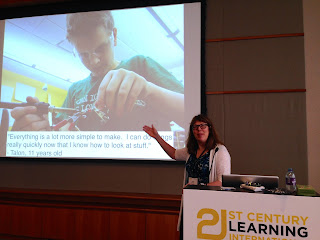
Sylvia started out as an electrical engineer who began her career in the aerospace industry, then moved to video game development, among which she created educational games. As she remarked, she, like several engineers, liked teaching children, and this desire to find out how people learned was what led her to get a postgraduate degree in education. She learned that the present generation of children didn’t have the kind of hands-on experiences she had while growing up, and this was part of the reason she teamed up with her co-author, Gary Stager, who has been teaching robotics and programming for thirty years, to write a book and make the so-called Maker Movement understandable to teachers and the general public.

The Maker Movement is a worldwide movement found in such countries as The Netherlands, Italy and India, wherein ordinary people take matters into their own hands to create things on their own, usually with the aid of computers and a three-dimensional (3D) printer, which is a printer that lays down layer after layer of plastic to create an item or a form, such as prosthetics and moisture sensors, relatively inexpensively and quickly, compared to present-day manufacturing processes. She notes that the wave is catching a lot of people unprepared and foresees a time when designs for three-dimensional printers can be bought on Amazon in the same way books are, and that three-dimensional printers themselves will become as commonplace as regular printers are nowadays.

Computers, Sylvia points out, are important to the Maker Movement, as these allow children to create iterative designs similar to the way engineers create their own designs in the real world, creating a real-world experience for children when it comes to experimentation and problem solving. Sylvia also notes that using computers to create objects is a fusion of art and science, as a knowledge of both is necessary to create something using a three-dimensional printer, which is actually more the case in the real world. She gave the example of a website called “Enable the Future,” where requests for prosthetic devices can be made, and the requests can be filled by children who have access to three-dimensional printers far more cheaply and inexpensively than by going through conventional channels.

She remarks that the Maker Movement ties in with the way kids should learn, by tackling their own problems, figuring things out on their own and making things that really work, effectively combining art and science, rather than having these separated, as they are in present-day conventional education, for purposes of efficiency. Sylvia remarks that studies, such as those being done by the Graduate Schools of Education of both Harvard and Stanford, are presently being conducted, which are pointing out that kids need to “mess around” to learn effectively, and those who have had the kind of experiences the Maker Movement offers feel that they can solve problems, which increases their confidence in their own capabilities. Children, she points out, learn by exploration and experience, and this was also pointed out by such educational experts as John Dewey and Jean Piaget, and remarks that these experts had been saying this for decades now.

Sylvia notes that the present educational system could be more improved to align with the way children learn, and gives tests as an example, for while tests might be useful in figuring out what a child doesn’t know, these don’t give an accurate picture of what the child already knows. She also notes that the same subjects have been taught in the same way for generations, and that these could be out of date, as in the case of mathematics, which has undergone a tremendous expansion since the end of World War II, yet remain unengaging to children, as in the case of history, where past events are taught as a series of dates that need to be memorized.

Sylvia is involved with CMK Press, which produces books that deal with the Maker Movement, and on a personal note, is considering writing a book about girls and science and engineering education.

Sylvia Martinez’s website for her book, Invent to Learn: Making, Tinkering and Engineering in the Classroom, is inventtolearn.com.

Purchase on Amazon: Invent to Learn: Making, Tinkering and Engineering in the Classroom

Saturday, June 27, 2015

Patricia Jennings Teaches How Mindfulness Frees Teachers from Stress

Dr. Patricia Jennings talks to Alexander “The Engineer” Lim of AuthorStory by alvinwriter.com about her book, Mindfulness for Teachers: Simple Skills for Peace and Productivity in the Classroom.


"We often get depressed about the past - what happened in the past. When we focus our attention on the present, it helps reduce both anxiety and depression." ~Patricia A. Jennings 

Patricia had always wanted to work with children and enjoyed working with them, which was the reason she went into teaching. She spent her first twenty-two years as a classroom teacher, after which she taught teachers, and it was over the course of that time that she realized how emotions can interfere with teaching, for, as she pointed out, both teachers and students are essentially held captive in a single room for a particular amount of time, and if the students complain and grumble and are generally not receptive to the teacher, this has an effect on the teacher, who reacts with such emotions that result in anxiety, thus making the experience rather stressful on the teacher.

Patricia had been practicing mindfulness and meditation even before she started teaching, and she realized that her practice of meditation helped her manage the emotional demands of being a teacher in a classroom full of children. She observed that, often, the behaviors that the teachers needed to manage created a negative emotional reaction in them, such as anger and frustration, and that the beginner teachers had a difficult time reflecting on such experiences. Patricia realized that teachers could benefit from practicing mindfulness, but she didn’t do so until she had done more research on the topic, which led her to get her doctorate studying stress and coping, after which she developed programs to help teachers manage their emotions through mindfulness, and gave the example of a beginning teacher who, after undergoing training in mindfulness, was able to make a subject that her students greatly resisted, interesting.

Mindfulness for Teachers was an opportunity for Patricia to bring together several threads that she had been working on over the years and present these in a way that the average teacher could get, so that they could be more responsive and become better teachers. She mentioned that one of the reasons she was interested in writing a book was her experience dealing with intern teachers, some of which she trained. She mentioned that Daniel Siegel, a clinical professor of psychiatry at the UCLA School of Medicine, recommended her to his publisher when the latter asked if he knew anybody who could write a book on mindfulness in education, and Patricia was up for the challenge, particularly since she had been thinking about writing a book but didn’t know how to get connected with the publishing industry.

The concept of mindfulness is based on Jon Kabat-Zinn’s work, which is based on stress reduction, and the definition of mindfulness is “paying attention to the present non-judgementally.” In other words, being aware of what is happening in the present moment, both within oneself and outside and oneself in a way that these are perceived very clearly. Mindfulness might be inherent in some personality traits, but it can also be practiced and can help people realize their conditioned responses to particular situations, such as being late.

While Patricia’s book is aimed primarily at teachers, she notes that the lessons within have helped readers who weren’t teachers in other aspects of their lives, such as parenting, and that the lessons within can help out anybody.

Patricia notes that research is presently ongoing on mindfulness, mostly conducted on adults, and practicing mindfulness has shown that it can reduce depression, anxiety and pain, as well as change parts of the brain that are related to regulating emotions and improving the response of the body’s immune system. She hopes that as teachers learn mindfulness skills, they would be more likely to stay in the teaching profession, particularly since teachers spend a lot of time on other activities outside of the classroom still related to teaching students - in other words, their work doesn’t end when classes do.

Patricia hopes that, at the end of the day, mindfulness can help teachers do their work in the classroom by understanding the entirety of the students they teach, particularly those who have suffered trauma and are acting out negatively due to that. She sees mindfulness as directly helping students as well. She says she wants to return to teaching students at some point in the future and use all the tools and techniques that she has learned over the years. She’s found her calling in teaching and she definitely has no desire to return to being a secretary for a real estate agent, which was where she started her working career. We should all be thankful for her choice.

Website: tishjennings.com

Purchase on Amazon: Mindfulness for Teachers: Simple Skills for Peace and Productivity in the Classroom