Showing posts with label success. Show all posts

Monday, April 12, 2021

Ryan Foland on Revealing the Surprising Power of the Real You for Greater Success - Ditch the Act (co-authored with Leonard Kim)

In this interview, Ryan Foland talks to Alexander “The Engineer” Lim, host of AuthorStory by alvinwriter.com, about his book co-authored with Leonard Kim, Ditch the Act: Reveal the Surprising Power of the Real You for Greater Success.


“Successful people are doing what everyone can do, but which not everyone does.” ~Ryan Foland 

As a child, Ryan was an outsider, not only because of his physical appearance (bleached blond and freckled) but also because he and his family spent summers on trips - and summertime was when elementary-school kids bonded together. “I think we all feel that we wanna belong,” he notes, adding that not being picked for a team, for example, hurts. His father noticed the changes in his behavior, as he was bullied, and this was when he took up karate. That experience made him realize that he was communicating in what was then a nontraditional way of communication, and that how one carried oneself was another way of communicating. This paid off as time went on, with Ryan noting that: “The more I learned how to be trained as a fighter, the less I actually fought.” He also entered athletics - wrestling and hockey - and this helped him become the senior high school class president.

As a sailor, Ryan’s analogy for his life is that he “ran into storms,” noting that, as a sailor, one doesn’t have control over the weather or the wind. Ryan admits that there are things in his past that he hid, as he learned that, to be successful, one needs to hide such things and to focus only on “the good stuff.” This is not possible nowadays, he remarks, adding that his co-author, Leonard Kim, “gained traction” only when the latter began sharing his failures as they happened - the complete opposite of what Ryan was doing. That partnership with Leonard enabled Ryan to understand the importance of opening up with others. This enabled him to own the things in his life that went wrong, and also made him realize how those events shaped who he has become. This, in turn, has enabled people to get to know him better compared to when he was still putting on an act. Doing so, he comments, allows people to see themselves in oneself, which “releases the pressure valve,” as one becomes more relatable to others.

“Narrogance” is when naivete and arrogance combine, and both Ryan and Leonard have experienced this. Narrogance is about the emphasis being on image and how people see one in the world being different from what is actually going on in one’s life, as well as of not asking for help. “That disconnect is something that really eats away at your soul,” Ryan notes, adding that there was a time when he owned a Range Rover with 22” rims and a Mercedes SL500 and wore suits and had all the other accoutrements of success, while he was having a difficult time paying his bills “behind the scenes.” It got to a point where Ryan felt he needed to file for bankruptcy, and needed to ask his parents for money to mail in the bankruptcy papers; and it was when he heard the slamming of the mailbox door, when he dropped his papers in, that it finally hit him that he had failed. His bankruptcy papers were returned, however, because he was short 32 cents, and Ryan saw it as a sign at a second chance, so he ripped up the paperwork and rebuilt his life from there.

Narrogance is all about “keeping up with the Kardashians,” according to Ryan, who points out that people have a perception of themselves as they want to show up in the world, which comes back to wanting to belong to a particular crowd, particularly with a crowd whose members seem to be successful. Ryan remarks that wealth, success and appearance don’t give a clear indication of what happens “behind the scenes,” remarking that there are several apparently successful people have shown themselves up to not be the successes they appeared to be after an overdose, accident or suicide.

On a more personal level, Ryan brought up the subject of people not being honest with their bosses for fear of the latter judging them. He notes that, if a person doesn’t communicate the challenges in their life, such as a relative who needs a lot of care, then that person’s boss can’t help that person out, to the point of the boss thinking that the person isn’t doing their job well. On the other hand, the boss might be able to help out if the person lets the boss know what is going on. This kind of dissonance, Ryan remarks, eventually grows and comes out “in pretty unhealthy ways.”

“Everyone has a personal brand,” Ryan remarks; “they just don’t know it.” One’s personal brand, he adds, isn’t just what one wants to be known for, but the intersection of this as well as what one has been in the past. He notes, as an example, researching on someone on the Internet, and then trying to “connect the dots” with what one has researched with one’s impressions when an actual meeting takes place. What makes a personal brand “exciting” is that one has control over some aspects of it, as well as having no control over other aspects. This, Ryan notes, creates an opportunity for people to get a better idea of who a person really is. He also explained the concept of “brand crumbs,” which are bits of information - such as a blog or a podcast - which sheds a little light on the person concerned as well as allows others to participate in the narrative. Everyone, Ryan adds, has a personal brand; it’s just that most people don’t offer the opportunity for others to participate in that personal brand.

Brands also change over time, with Ryan pointing out that the brand crumbs of kids change as they grow up, as an example. “The mistake people make,” he notes, “is that, when you’re branding your personal brand as an adult, they tend to either neglect or ignore or bury everything that’s happened in the past.” By someone focusing only on that person’s successes, Ryan believes, others cannot relate to such successes, and showing one’s vulnerabilities and struggles help others relate to the success reached.

“We all have a B.S. sniffer,” Ryan remarks, and this is why authenticity is important, as people aren’t willing to connect with an inauthentic person. A person’s values, for example, can resonate with others, which means that a connection has been formed. Being human is a possible way to get ahead in the world today, with Ryan then giving the example of an employer doing an Internet search on a potential employee. Chances are, he wouldn’t find anything related to the person’s back story, and if he did, he would only find the successes posted. Biographies and resumes tend to be highlight reels, and these don’t offer an opportunity for connection, so Ryan believes that letting others know one’s back story is an excellent opportunity to connect and build rapport, as well as to get to know a person as a person, rather than just a figure. Fear is the reason why people “default” to a safe route, Ryan admits, that notes that the power created by connection outweighs the fear that is present. Ryan notes, however, that allowing other people to see one’s humanity allows those other people to see you as another human being, and thus more relatable.

Being transparent and showing one’s vulnerabilities is commonly seen as a weakness, but Ryan points out that doing so is actually a sign of courage. This offers the opportunity for sharing with others, and as Ryan remarks: “Somebody’s got to go first,” adding that others will chime in after that, and that people will be there for one after that. He also notes that everyone has experienced failure, and that people don’t know how to show these in such a way that others will know who one is; and this is what Ditch the Act is all about, so that one can build one’s brand authentically, rather than by “hacks and apps.”

Purchase from Amazon: Ditch the Act: Reveal the Surprising Power of the Real You for Greater Success by Leonard Kim and Ryan Foland 


Saturday, April 25, 2020

Christine Brown-Quinn on Unlocking Your Career Success


In this interview, Christine Brown-Quinn talks to Alexander “The Engineer” Lim, host of AuthorStory by alvinwriter.com, about her book, Unlock Your Career Success: Knowing the Unwritten Rules Changes Everything.


“Take ownership of your career.” ~Christine Brown-Quinn

Christine Brown-Quinn has spent thirty years in the corporate world and has become a Managing Director in International Finance, moving from the United States to London to pursue her career, as part of a wave of people who were recruited to London to strengthen the financial industry there. It was in 2010 when the bank she was working for launched a Women’s Network, which Christine had no idea what was about, as she was used, by then, to being “the only woman in the room.” When Christine asked why she was being asked to give a talk at that summit, she was told that she had a successful career as well as a family, and women would be interested to know how she did it. It was from this that she realized that the skills she did at work were ones which she transferred to her home, and vice versa, remarking that people actually become better parents and partners because of the skills they can pick up at work. Where things brought from personal life are concerned, Christine remarks that it is the values that are taught at home are the things which one brings to work, and gives an example of when her children called her out on her not doing something which she said she did.

It was during the talk, however, that Christine realized that her work was now to coach other women about how to have both a career and a family life, given the framework of both aspects of one’s life supporting each other. It was during the summer after that talk, which took place during the financial crisis of 2010, that she left the banking industry and set up her own career consultancy business, then turned that into her first book. Unlock Your Career Success is her second book, and the seed of this was planted when several of her clients mentioned that she needed to write it. “I woke up in March 2019, and the whole book was in my head,” Christine confesses, adding that what the book’s subject matter covered was essentially what she had been talking about for the past ten years.

Christine admitted that, when she left the university, her idea of career progression was all about “doing a great job;” that said, she remarked that that is only what starts off one’s career, and that it is up to the person themselves to ensure that their careers progress, as a company’s HR or a person’s manager is not responsible for that.

Christine offers the following question for women who have both family and career: “As a parent, how am I at my best?” She notes that everyone is individual, and that a “one size fits all” approach doesn’t work, so people need to think about the ways by which they will be happy, remarking that her being at home with the children all the time isn’t something that she could do well. Having a career was thus very necessary for Christine, as work stimulated her and fulfilled her being a mother.

Where work is concerned, Christine notes that the issue is that of having a mismatch in culture, noting that, when women enter the workplace, they want to feel good about the value they’re bringing as well as feel good about their organizations, working in a way that “feels more natural” to them. She notes that a lot of women look for leadership role models in the corporate world, leaders who are willing to collaborate and bring the best out in others, and that this is more of the issue than anything else. Christine also remarks that people want their work to be meaningful in that, if one has children, one desires more that the time spent away from family counts.

Christine’s most targeted audience is women in corporate environments, as she helps women navigate the issues and leadership styles in such an environment – something she has had a lot of experience with, given her corporate career. She gave the case study of one of her clients, Candida, who worked for a technology company who had worked very hard but whose career stalled out. Christine was able to coach Candida into getting the kind of position she liked, by focusing on a digital start-up department that she was interested in getting into and by using her network of contacts to send the head of the department some suggestions. These suggestions interested the department head and, thanks to Christine’s coaching, Candida asked open-ended questions which gave her more insight into concerns within the department that she could help out with. As a result, Candida is now in a position, in that department, that fulfills her.

Christine notes that the rules in the book are intended to establish career-enhancing mindset and behaviors which are needed to achieve career progression, within the context of what makes one happy. She notes that one has to plan one’s career and nourish one’s network are critical to helping one’s career progress; and the latter is particularly important when getting a broader understanding of the challenges facing the company, as one can then provide suggestions which can address said concerns. The unwritten rules, Christine also remarks, resonates more with women than with men, as the way women navigate the world is different from the way men do so. That said, men can also pick something up from knowing these rules as, while they know those rules, it articulates those rules and gives an awareness of the way women think, as the viewpoint the rules show is an alternative one which they can use to help others.

“The best way to sell is to understand the need of the client, and then address it,” Christine notes. She also remarks that, in today’s environment, the challenges of technology and the pace of change is very fast. That said, the chaos that exists in today’s environment also creates opportunities, Christine believes, and this gives people an opportunity to align the needs of the organization with one’s own values and the value that one can add to the organization. “That’s what job security looks like, now and in the future,” she concludes.

Purchase from Amazon: 
Unlock Your Career Success: Knowing the Unwritten Rules Changes Everything by Christine Brown-Quinn

Thursday, November 28, 2019

Paul Smith and The 10 Stories Great Leaders Tell (for Leadership and Sales Success)

In this interview, Paul Smith talks to Alexander “The Engineer” Lim, host of AuthorStory by alvinwriter.com, about his book, The 10 Stories Great Leaders Tell.


“Be honest.” ~Paul Smith

Paul remarks that his working career was typical, in that he took a job with large corporations such as Accenture and Proctor and Gamble after graduating from college with a bachelor’s degree in economics, after which he got a master’s degree in business. He got involved with storytelling when he realized that storytelling was something which leaders should have, thanks to the leaders he admired while he was in Proctor and Gamble. “They didn’t teach me that [storytelling] in undergrad, they didn’t teach me that in business school,” he remarks about his frustration when figuring out what storytelling was all about. He thus set out on his own to explore the realm of storytelling, which is how he is where he now is, as a storyteller.

For Paul, storytelling is “telling a story about something that happened to someone.” A story is thus not a speech, a presentation or a memo with bullet points, but a narrative that has a time, place, a main character that has a goal, an obstacle in the way of getting to that goal, events that take place along the way and an ending with a resolution. Paul notes that there are eight questions that a good story must answer, and these are:

  1. Why should I listen to the story? (The answer to this must be given by the storyteller, so the audience has a reason to listen to the story.)
  2. Where and when did it take place?
  3. Who’s the main character, and what did they want?
  4. What was the problem or opportunity that they ran into?
  5. What did they do about it?
  6. How did it turn out in the end?
  7. What did you learn from the story?
  8. What do you think I should go and do, now? (This question is something that the audience needs to answer.)

Paul remarks that all stories share the same common traits; that said, in business stories, the audience is the one who needs to summarize what is learned and figure out the next steps to be taken. Storytelling is becoming popular as a means of communication within businesses because it works at getting people to think and feel what it is that needs to be done, according to him, and this is because stories communicate with both the logical/rational and the emotional parts of the brain. A list of reasons, on the other hand, only communicates with the logical/rational part of the brain, which makes this method fall short, as Paul notes that human decisions are made in the subconscious, emotional part of the brain, after which these decisions are rationalized. He also notes that facts and data are between six and 22 times more likely to be remembered if these are told within a story compared to if these were merely given as a list, which makes these facts more likely to be acted upon.

Paul mentioned that, in the three books he wrote prior to The 10 Stories Great Leaders Tell, he covered some 70 different types of stories and 250 examples of these types of stories. He was thus often asked: “What are the most important ones?” and he would give different answers each time. He decided to narrow his focus on a particular type of story when a publisher contacted him to write a book which could be read in an hour’s time, and he chose the field of leadership because several of his clients, who are leaders in their respective fields, ask him how to tell stories which could help them with their work.

The ten kinds of stories great leaders tell, according to Paul, are:

  1. Where we came from. (This is a founding story.)
  2. Why we can’t stay there. (This is a case for change story.)
  3. Where we’re going. (This is a vision story.)
  4. How we’re going to get there. (This is a strategy story.)
  5. What we believe. (This is a corporate values story.)
  6. Who we serve. (This is a story about the customer.)
  7. What we do for our customers. (This is a classic sales or customer success story.)
  8. How we’re different from our competitors. (This is a marketing story.)
  9. Why I lead the way I do. (This is a personal leadership philosophy story.)
  10. Why you should want to work here. (This is a recruiting story.)

Paul gave, as an example, a personal leadership philosophy story of Mike Figliuolo, who was a West Point graduate who was assigned to lead a platoon of tanks. In one of his first training exercises, despite the planning that had been done beforehand, he found himself in a situation where he was leading a force of 400 tanks against an opposing force of 400 tanks and had to pick a direction at a time where he was somewhat confused. Mike could have spent thirty seconds stopping where he was and studying his map to figure out what to do - which is a long time, given that the opposing force was likewise looking for him so they could “kill” him and the tanks he was leading. Mike made a decision on the fly to head in one direction, and within seconds of doing so, he and his entire platoon were taken out. The tanks behind him, however, saw what happened and turned in the other, correct direction, subsequently took the high ground and, in the end, won the exercise. The lesson Mike learned was that it is sometimes better to make the wrong decision quickly than the right decision slowly; and since life gives quick feedback on whether the decision taken is right or wrong, provided one doesn’t get killed by it, one can adjust and figure out what to do next, rather than get stuck in analysis paralysis. This explains why Mike is a quick, decisive leader who forgives his people for making mistakes, so long as they learn from it.

Paul notes that leaders have a difficult time telling strategy and vision stories because they don’t know the difference between a strategy document or a vision statement from a strategy or vision story. He remarks that a story for these would run along the likes of what it would be like for someone to work in a company once the latter has achieved the vision, and that, if the story is attractive enough, people will want to pitch in to achieve that vision. The founding story of the company, on the other hand, is the kind of story that leaders find the easiest to tell, because they know it by heart, because it is the most often told and is most obviously a story.

Paul recommends that people who are looking for the stories to tell need to ask for these stories from the people they work with. He recommends creating a wish list for the kinds of stories needed, and then asking around for these. He notes that, in each chapter of the book, there are guides on why such a story would be important as well as tips on how to find such stories within a company, as well as the kinds of questions to ask. He also reflects that he might want to add a “Why you want to invest in us?” story, as this is something that smaller companies need to convince people to invest in them.

Paul points out that storytelling is just one tool in one’s communication kit, and that, in general, people should be honest whenever they communicate. He also notes the popular impression is that those who tell stories effectively are natural-born storytellers, and that one is either a storyteller or not. This isn’t the case, Paul remarks, and adds that, if people want to tell stories, they should take lessons on how to do so from people who know how to do so, as storytelling is a skill on its own.

Purchase from Amazon: 

The 10 Stories Great Leaders Tell by Paul Smith


Friday, October 18, 2019

Thomas W. Jones on His Journey From Willard to Wall Street

In this interview, Thomas W. Jones talks to Alexander “The Engineer” Lim, host of AuthorStory by alvinwriter.com, about his/her book, From Willard Straight to Wall Street: A Memoir.


“Every person can control those things: that you did your best, you kept the faith and you went as far as you could.” ~Thomas W. Jones

In this interview, Thomas W. Jones talks to Alexander “The Engineer” Lim, host of AuthorStory by alvinwriter.com, about his/her book, From Willard Straight to Wall Street: A Memoir. “Every person can control those things: that you did your best, you kept the faith and you went as far as you could.” ~Thomas W. Jones Tom, by his own admission, had “an unusual childhood” for an African-American child, as his father got a Master’s degree in Physics, after which he was employed in the defense industry, becoming a senior engineer on the Atlas guided intercontinental ballistic missile project. He acknowledges that he and his family experienced the harshness of racial segregation as well as overcame the barriers associated with this, courtesy of education. Tom’s father’s keys to success were: commitment to God, education and hard work, which he passed on to Tom and his family, with Tom noting that personal morality and moral discipline are critical to elevating one’s life.

Tom notes that, when he was admitted to Cornell University, there were 35 African-Americans in his freshman class, whereas there were only 23 African-Americans who were ever admitted to that date - and Cornell University had a student body of around 12,000. He also notes that, in a five-year span in the 1960s, four prominent people had been assassinated and riots raged across cities in the United States, particularly during the summer. It thus appeared that a violent uprising from the black population was likely, and it was against this background that the Straight Hall siege took place. It was during his college days that Tom came in contact with African-Americans who came from backgrounds which were more challenging than his, which made him realize the degree of oppression inflicted upon African-Americans in centuries. He and his peers felt that it was their generation’s responsibility to “draw the line” and end their oppression, and while he was well-accepted in Cornell, he identified with that particular cause.

Tom and his fellow African-Americans had been working for a black studies curriculum in the university, to bring into the fore the effects of slavery in the United States, and in the process of such agitation, several African-American students had been sanctioned, which led to the takeover of Willard Straight Hall. Those who took over initially didn’t carry weapons, but after the Delta Epsilon fraternity members - all of whom were white - broke in and attempted to push these out. Tom notes that this was viewed by him and his fellows as white vigilatism, and it was after this attempt was rebuffed that guns were brought into the building. The university administration quickly realized that the siege could spin out of control, which was why the takeover was quickly settled. Tom remarks that the symbolism given by the siege was that African-Americans were no longer intimidated by white vigilantism and were willing to fight to support the cause of educational truth and opportunity about American history, rather than being subjugated as previous generations had been.

Tom notes that American history is full of contradictions, pointing out that, while many white Americans engaged in racism, there have also been white Americans of conscience who worked with slaves and former slaves. He noted that, at the time of the Willard Straight Hall siege, the United States was at a “fork in the road,” where they could have gone the road of oppression or moving on a path of liberty, and Tom wanted to be part of the liberalizing path that the United States then took. He also wanted to go into business because he realized that the greatest resistance to integration would be where the money was, and so acted accordingly. When he began his road into a business career in the 1970s, he figured his chances to be low, and he realized that he could only focus on what he could control, which were his attitude, how hard he could work and his commitment to excel in that which he did. “You can do these things and not succeed,” Tom notes, “but you will know, in your heart, that you have done all that you can possibly do, and that’s all that any person can do.”

It was during his climb up the corporate ladder that he realized that there was a gap between giving 100% of one’s effort and the culturally-conditioned 95%, in that, while that difference was small, the cumulative results eventually add up, where achievement and results were concerned. It was this which attracted the attention of his bosses in senior management, who, Tom notes, are like coaches in sports teams who are always scouting for good talent, as the executive with the best team would be the one who would deliver the best results. His subsequent bosses offered promotions, protection and opportunities, while Tom reciprocated by making them look good, thanks to his own performance. “All affirmative action does,” Tom notes, “is get you in the door. It is rare, in corporate America, to determine the winner in those high-level positions that everybody is striving for.” He also noted that, throughout his career, his white peers didn’t see him as competition, which made him greatly underestimated - a huge advantage.

Tom shared that his lesson of giving 100% commitment to being the best one can be is something that individuals don’t know what that really is until an individual gives in everything that he or she has and realizes what he can be, and this enables people to achieve their highest potential. He also shared that, at the beginning of every year, he would note down three overarching goals, some of which could be technical, others of which could be physical or spiritual objectives. He gave the example of his setting down, in 1982, of reading the entire Bible from cover to cover, noting that, given his background, it was “foolish” for him to come to the end of his life without reading what, for him, was the most important book ever written, particularly as it was the basis of several of his own life’s concepts.

When asked about the collapse of Citigroup’s stock price in the 2000s (the company’s stock price in August, 2002 was in the $300 per share range, with a high of around $368 per share, declared insolvency in November 2008, and its share price dropped to 97 cents per share in early April, 2009), Tom explained that the Citigroup general counsel Charles Prince was chosen by the then-retiring CEO Sandy Weill over Citigroup’s President, Robert Willemstad, who was well-regarded by a lot of the senior managers, as well as the other business leaders. Tom remarks that, within two years, all of the senior business leaders at Citigroup were out of the company, with Tom himself being fired in 2004. Charles Prince then placed his own people in the vacated senior leadership positions, a move which Tom notes that was due to Charles’ own insecurities. This resulted in a senior management which told Charles what the latter wanted to hear, rather than factually based on what was actually going on, and all this came to a head in 2008, when Citigroup ran into a lot of trouble when the mortgage security crisis occurred.

Were Tom to meet God, he would like Him to say: “Thomas, you have fought the good fight, you have kept the faith and you have finished the race.”

Purchase from Amazon: From Willard Straight to Wall Street: A Memoir by Thomas W. Jones

Saturday, October 10, 2015

Gordon Tredgold Shows the FAST Way to Succeed in Any Business or Company

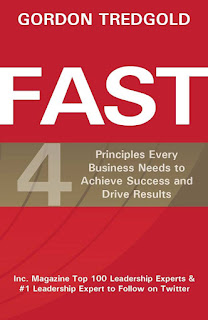
Gordon Tredgold talks to Alexander “The Engineer” Lim, host of AuthorStory by alvinwriter.com about his latest book, FAST: 4 Principles Every Business Needs to Achieve Success and Drive Results.


A more successful world is a better world to live in.” ~Gordon Tredgold

Gordon has a degree in mathematics and began his career in 1986, working in IT, and over the course of the next three decades, proved his worth at handling projects and solving problems, specializing in projects that people thought difficult, and thus didn’t want to handle. He liked handling such projects because these allowed him to break the rules, and as a result, was able to bring about change when and where it was needed. While handling such projects, he learned what caused failure, which are a lack of focus, a lack of accountability, a lack of simplicity and a lack of transparency.

Where failure is concerned, Gordon quoted some interesting statistics:

  • 60% of IT projects fail
  • 80% of all businesses fail within eighteen months (from Forbes magazine)
  • 90% of solopreneurs fail
  • 42% of solopreneurs fail because there is no market for their product (from a Fortune magazine article)
  • 95% of product launches fail
  • 24% of businesses run out of money to support themselves before they turned a profit

Gordon points out that these failures most likely stemmed from making basic mistakes, and the book, FAST, is essentially a distillation of what he learned from what causes businesses to fail and what enables them to succeed, be they multibillion-dollar businesses or small businesses, and to avoid the negative impact of failure. He wrote the book essentially as a way to create a legacy for himself, by creating a way by which others can achieve results and success more than he could by either helping them out or giving seminars

Gordon remarks that he can explain things in a way that people can easily understand, thus making the lessons within his book understandable and actionable. As an example, he mentioned that he brought up the case of a USD 50B utility company that wanted to reduce expenses at a talk he conducted in Morocco, and he was able to break down the problem, which was related with system testing, so that members of the audience who had no background in system testing were able to easily home in on the best way for that company to reduce expenses. He keeps his explanation simple and understandable because he wants to give his readers as much information and tools as possible so they can get whatever job they are working on done.

Where success is concerned, the four components that Gordon espouses are:

F - Focus: what are you trying to do?
A - Accountability: who is going to do the work?
S - Simplicity: how are we going to approach the work?
T - Transparency: “how far;” honesty in how well one is doing, and the visibility of the work involved.

Gordon also gave further explanation on terms that are often confused with each other
Simple and easy. Gordon gave an analogy from boxing, in that, if he went up against Manny Pacquiao, his simple plan would be to rush over to where Manny Pacquiao was, once the bell was rung, and then knock him out with one punch. Chances are, however, such a plan would not be easy to accomplish.

Effectiveness and efficiency. Gordon gave the analogy of a car stuck in mud, with the driver running the engine and the wheels so that the latter spin quickly. The car delivers the power to the wheels efficiently, enough that the wheels spin quickly, but the effectiveness of the action is questionable, as the car is unlikely to get out of the mud and moving forward, which is a measure of how effective a car is.

Accountability and responsibility. Gordon gave the analogy of a soccer team, wherein the manager is accountable for the team’s performance, which includes hiring the people he needs and calling the plays to be run, while the players are responsible for the actual plays that will be executed.

Gordon’s favorite success story was when he dealt with an entrepreneur whose business was making USD 20,000 a month. Gordon was brought in to enable that company to generate double that amount. He noted that the company didn’t know how much profit they were making, and that, if they doubled their revenue, they could also be doubling their losses. He also noted that, if the company were making only 5% profit, this would be a net income of USD 1,000 a month, which is equivalent to that of a basic job in the United States, whereas if, by properly selecting the components of their product, they generated 50% profit they would have a net income of USD 10,000 a month, which would be more along the lines of what a business should make. Although, after all was said and done, revenues initially dropped to USD 15,000 a month , the company was making 50% profit, or USD 7,500 a month, which was a decent number for a business.

To leaders, managers or company owners who are doing an existing project, Gordon advises that they rate themselves, on a scale of zero to five, with five being the best, on each of the four FAST principles, and then pick on that area with the lowest score to work on first. to leaders, managers or company owners who are just starting out in a new endeavor, Gordon advises starting on Focus to aim at the right target.

Although Gordon admits it would be nice to make money out of selling a million copies of his book, his intention is more aligned with his desire to create a legacy for himself by reducing the rate of failure in business, as he believes that a more successful world is a better world to live in. He is also presently working on two follow-up books to FAST, which he’s initially calling FASTER and FASTEST, both of which focus more on people, as well as a version of FAST which is aimed specifically at entrepreneurs.

Gordon is an avowed rugby fan, as he used to play it in his younger days. He hates routine or mundane activities that he’s not allowed to improve upon, and hopes to become the CEO of a major corporation where he can efficiently apply all the techniques and lessons he has learned in the past three decades, or to become the manager of a football team.

Gordon Tredgold’s website for his book, FAST: 4 Principles Every Business Needs to Achieve Success and Drive Results, is gordontregold.com.

Purchase on Amazon:  FAST: 4 Principles Every Business Needs to Achieve Success and Drive Results

Saturday, September 12, 2015

Chris Swanson on Crushing Your Failures & Changing Your Life

Chris Swanson talks to Alexander “The Engineer” Lim, host of AuthorStory by alvinwriter.com about his book, Tinman to Ironman: 26.2 Proven Ways to Crush Your Failures and Transform Your Life Today!


"When you look at your life as a wheel, and in the center is you, all aspects of your life - your family, your finances, your personal development, your faith - all those things have to have attention, and if we neglect any one of those areas, then our life is gonna be out of balance." ~Chris Swanson

For Chris, tin is a metal that is shiny and looks good on the outside but crumples easily, while iron is a metal that might not look as good as tin - it could even look somewhat scratched and dented - but it doesn’t collapse as easily as tin does under pressure. In the year 2000, Chris realized, while looking at himself in the mirror that he was a Tinman, and after taking stock of his life, when he realized that he had been a Tinman in his physical, educational and professional lives, he decided to become an Ironman by putting certain principles in action. By doing so, he attained a Master’s degree from the University of Michigan, became a police commander in Flint, Michigan (which, according to Chris, is one of the most violent cities in the United States - a statement Forbes supports) and running his first-ever Ironman competition (which consists of a 2.4-mile swim, followed by a 112-mile bicycle route, finishing with a full marathon of 26.2 miles) in 2007, and he has done four such competitions by 2015. Since then, Chris has mentored and coached “hundreds” of people into becoming Ironmen.

The book has 26.2 chapters, which is an homage to the length of a marathon (26.2 miles), with each chapter having three parts - an “Iron Kid” story, an “Iron Athlete” story and an “Iron Cop” story, and after each story are “Iron Action” steps for readers to benchmark against and, if they’re not doing these, to implement into their own lives. He admits that the hardest part of the writing process was finding time to write the book out, as he has a full-time job and trains for Ironman competitions, as well as also wondering if people wanted to hear what he had to say, and that the easiest part of the writing process was making the title. Chris intended the book to be a simple read, inspirational, relatable, engaging and yet hard-hitting and substantial, and from the feedback he got from the people who have read it, such as the man who made his rebellious daughter read From Tinman to Ironman, it puts its points across very effectively. He also notes that the book keeps him humble and accountable, as he can’t preach the principles found in the book without first applying these to himself, and that the impact he consequently has on other peoples’ lives is a great responsibility.

Chris points out that hunger for change and development is what makes an Ironman an Ironman, while a Tinman does not have this hunger, and he sees this in a lot of Tinmen, such as fathers and entrepreneurs. Chris notes that, we can’t do anything about our genetics or about our environment, but we do have choices on how we respond, and it’s up to people to make their choices, and while there are many important qualities and traits possessed by an Ironman, hunger is the starting point for everything, and hunger springs from the hope that a particular desired future will become real.

Chris has a strong spiritual foundation based on his belief in Christ, which is the key foundation of his life, and he is very present to life being cut short at any time, as he encounters the worst of humanity in the course of his work in law enforcement. He made the point repeatedly throughout the interview that all of us are students of leadership, which starts with leading oneself, and notes that, from the feedback he got, the book enables its readers to set small goals that lead up to the transformation of their lives.

Chris is already working on another book, which he mentioned is titled Blood, Guts and Things That Make You Go Nuts, which is about transcendence. Chris notes that the theme within this is about living one’s life in accord with one’s intention, and his doing so in his own life is summed up by what he hopes God will tell him when he passes on: “Well done, thy good and faithful servant.”

Chris Swanson’s website for Tinman to Ironman, is swansonleadership.com.

Purchase on Amazon: Tinman to Ironman: 26.2 Proven Ways to Crush Your Failures and Transform Your Life Today!

Friday, March 13, 2015

Welcome to AuthorStory Blog!


Welcome to AuthorStory!

AuthorStory is about inspiring stories of authors and their books. We talk to them and you walk with them as they share their experiences and inspiration in becoming successful authors.

I am Alexander "The Engneer" Lim and I am your host on AuthorStory.

Enjoy!