Friday, March 25, 2016

Jenny Johnston on Healing Soul Trauma Using Past Life Regression

Jenny Johnston talks to Alexander “The Engineer” Lim, host of AuthorStory by alvinwriter.com about her book, Tapping Into Past Lives.


“I take people up into their higher learning so that they’re looking down on their life and seeing it differently and getting the higher learning from that.” ~Jenny Johnston (on past life regression)

Jenny is an occupational therapist by profession who discovered EFT while working for her hypnotherapy diploma, and she then began using it in her work to help her clients resolve their personal issues. She was also interested in past life regression and combined this into her work after receiving messages from the spiritual channeler Kryon about “mining the Akash,” which is about remembering one’s past lives to mine the gifts found there. At present, she works with whom she calls “higher guides” to release the blocks that are keeping people from progressing in this lifetime, or to recall positive aspects of past lives that can be used in this present lifetime.

EFT, commonly called “tapping,” is part of a field called “energy psychology” and is the most well-known. It involves using the body’s acupressure points to deactivate the body’s fight or flight instincts and create a state of relaxation, as well as using cognitive methods to bring one’s brainwaves from the conscious down into the subconscious. This enables one’s body to be able to identify a trauma and then release the body’s instinctive response to it, thus creating a calmer response to that issue. Quantum EFT is an aspect of EFT that Jenny created, based on her knowledge that sprang from past experience with her clients, wherein a person steps into that memory of when that trauma began, whenever it might have started, releases the beliefs around that trauma, and learns higher lessons from that situation and bringing these into one’s present life. Unlike standard methods of hypnotherapy, the client is awake all throughout the session.

During the course of her practice, Jenny discovered that a lot of traumas in people’s present lifetimes had an origin in their past lives, and these are essentially “soul traumas,” and that people who don’t necessarily believe in past lives weren’t able to figure out why they were sabotaging themselves until they discovered the source of this, which sprang from a past life. Soul traumas aren’t necessarily limited to the emotional and the psychological, Jenny noted, but can also manifest themselves physically. Jenny gave an example of a woman who suffered from severe headaches that normal therapy couldn’t resolve, who, after undergoing sessions with her, discovered that that woman had been a businessman in a previous life who had died from head injuries suffered during a car accident. Once the woman had undergone therapy with Jenny to clear and resolve that issue, her headaches were gone.

Jenny wrote her book because she felt that the stories and experiences she had gathered throughout the course of her practice, be it in private sessions or in her workshops, were so profound and amazing that these needed to be shared. She also hopes that some readers will get their own “A-ha!” moments about such possible things in her life, and mentioned that readers don’t necessarily have to believe in past lives to get something out of it. Jenny also included links to various videos where people talked about or revealed their experiences. She remarked that having an “ideal reader,” someone whom she could envision whom she was writing her book for, helped out greatly where writing the book was concerned. For Jenny, writing the book has enabled her to step into her true purpose, stepping out of occupational therapy and becoming an EFT practitioner and trainer full-time, which is what she loves to do.

To those who are suffering from trauma, Jenny recommends that they deliberately create the intention to go to the trauma’s origin, wherever or whenever it might be, and to see it as part of a whole, as the trauma might have begun a long time ago. She also advises people to view their life as being not just the one in the present, which is but one chapter of the life of their soul, but to recognize themselves as their soul. She hopes the book will enable its readers to access the healing from wherever they are in the world, without Jenny needing to physically be with people to help them out.

Jenny Johnston’s websites for her book, Tapping Into Past Lives, are jennyjohnston.com.au, as well as quantumeft.com.au, tappingintopastlives.tv.

Friday, March 18, 2016

Lynn Jackson on Mermaids and Aiden, the Merman Prince of the Sea

Lynn Jackson talks to Alexander “The Engineer” Lim, host of AuthorStory by alvinwriter.com about her merman book, Aiden: Prince of the Sea.


“I’ve always had a child’s heart.” ~Lynn Jackson

Lynn had always loved anything to do with the sea, and had always been interested in mermaids. To be different, however, she decided to write a story with a merman rather than a mermaid, and this was how she came up with the story, with Aiden being a merman prince. The other main character in the story, Dana, is a sixteen-year old girl who wasn’t in the popular set in high school and was bullied for the wrong reasons, and over the course of the book, they teach each other various things about each other’s society and world. Lynn also wrote the book in a way that reflected the ways by which we humans, as a species, interacted with our environment - both the good and the bad impacts humans have had. Dana remarked that it’s a family story which adult readers can enjoy as well, and she hopes that this opens up the “child’s heart” in adults.

Dana had started out as an author writing children’s stories, so despite her also being the author of the dark House of Dorstanton vampire series, it wasn’t a stretch for her to write Aiden: Prince of the Sea, whose fantasy characters aren’t broody vampires. She admits that there is an aura of beauty and fantasy about merfolk that make them attractive to the ordinary people, and she noted that she made Aiden as real as she possibly could, including such details as what Aiden eats and what his enemies are, to the point of making him a bit of a “smartass” (in Lynn’s words) so that the reader could believe that he exists in reality. Lynn also did research on such things as surfing, which is an integral part of the story, as well as on sharks.

It took Lynn around three months to write Aiden: Prince of the Sea, but she admits that the editing process took up a lot of time. Lynn admits that she goes over the stories she writes four or five times over, after which she has her husband, Mark, and others whom she trusts, look them over as well to make sure the words are correct, and admits that, sometimes, corrections are spotted only after a manuscript has been checked over around a dozen times.

To those who are considering writing a fiction book, Lynn recommends that they pick something they enjoy and then go with the flow of things. She recommends thinking up personalities and the character’s environs, including friends and enemies. She says that a lot of her characters in her stories just grow on their own and gave troll characters, which are always antagonists, as an example.

As of this writing, Lynn has come up with a new Christmas story which she hopes to get released before The Holidays, and is also still working on the House of Dorstanton series. She has also released Taming the Steel, which is a modern Western/steam punk science fiction story, as well as Hauntingly in Love, which is a ghost story. Aiden: Prince of the Sea, is a bestselling book in England.

Purchase on Amazon: Aiden: Prince of the Sea

Friday, March 11, 2016

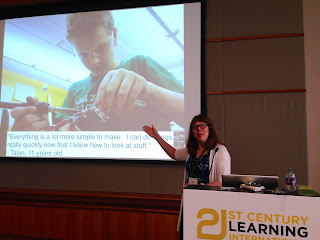
Sylvia Martinez on Inventing & the Maker Movement in Education

Sylvia Martinez talks to Alexander “The Engineer” Lim, host of AuthorStory by alvinwriter.com about her book, Invent to Learn: Making, Tinkering and Engineering in the Classroom, which she co-authored with Gary Stager.


“Learning is about experiencing something firsthand.” ~Sylvia Martinez 

Sylvia started out as an electrical engineer who began her career in the aerospace industry, then moved to video game development, among which she created educational games. As she remarked, she, like several engineers, liked teaching children, and this desire to find out how people learned was what led her to get a postgraduate degree in education. She learned that the present generation of children didn’t have the kind of hands-on experiences she had while growing up, and this was part of the reason she teamed up with her co-author, Gary Stager, who has been teaching robotics and programming for thirty years, to write a book and make the so-called Maker Movement understandable to teachers and the general public.

The Maker Movement is a worldwide movement found in such countries as The Netherlands, Italy and India, wherein ordinary people take matters into their own hands to create things on their own, usually with the aid of computers and a three-dimensional (3D) printer, which is a printer that lays down layer after layer of plastic to create an item or a form, such as prosthetics and moisture sensors, relatively inexpensively and quickly, compared to present-day manufacturing processes. She notes that the wave is catching a lot of people unprepared and foresees a time when designs for three-dimensional printers can be bought on Amazon in the same way books are, and that three-dimensional printers themselves will become as commonplace as regular printers are nowadays.

Computers, Sylvia points out, are important to the Maker Movement, as these allow children to create iterative designs similar to the way engineers create their own designs in the real world, creating a real-world experience for children when it comes to experimentation and problem solving. Sylvia also notes that using computers to create objects is a fusion of art and science, as a knowledge of both is necessary to create something using a three-dimensional printer, which is actually more the case in the real world. She gave the example of a website called “Enable the Future,” where requests for prosthetic devices can be made, and the requests can be filled by children who have access to three-dimensional printers far more cheaply and inexpensively than by going through conventional channels.

She remarks that the Maker Movement ties in with the way kids should learn, by tackling their own problems, figuring things out on their own and making things that really work, effectively combining art and science, rather than having these separated, as they are in present-day conventional education, for purposes of efficiency. Sylvia remarks that studies, such as those being done by the Graduate Schools of Education of both Harvard and Stanford, are presently being conducted, which are pointing out that kids need to “mess around” to learn effectively, and those who have had the kind of experiences the Maker Movement offers feel that they can solve problems, which increases their confidence in their own capabilities. Children, she points out, learn by exploration and experience, and this was also pointed out by such educational experts as John Dewey and Jean Piaget, and remarks that these experts had been saying this for decades now.

Sylvia notes that the present educational system could be more improved to align with the way children learn, and gives tests as an example, for while tests might be useful in figuring out what a child doesn’t know, these don’t give an accurate picture of what the child already knows. She also notes that the same subjects have been taught in the same way for generations, and that these could be out of date, as in the case of mathematics, which has undergone a tremendous expansion since the end of World War II, yet remain unengaging to children, as in the case of history, where past events are taught as a series of dates that need to be memorized.

Sylvia is involved with CMK Press, which produces books that deal with the Maker Movement, and on a personal note, is considering writing a book about girls and science and engineering education.

Sylvia Martinez’s website for her book, Invent to Learn: Making, Tinkering and Engineering in the Classroom, is inventtolearn.com.

Purchase on Amazon: Invent to Learn: Making, Tinkering and Engineering in the Classroom

Thursday, February 25, 2016

Dr. Raphael Travis Jr. on the Social Healing Power of Hip Hop Culture

Dr. Raphael Travis talks to Alexander “The Engineer” Lim, host of AuthorStory by alvinwriter.com about his book, The Healing Power of Hip Hop (Intersections of Race, Ethnicity, and Culture).


“Hip hop is a fuel for life.” ~Dr. Raphael Travis 

Dr. Raphael Travis is presently an associate professor of Texas State University, in the School of Social Work, in San Marcus, and is a licensed social worker who received his doctorate in public health from UCLA. He grew up in Rosen, New York, and for him, hip hop had always been a part of his environment and his life, without having the identity it is presently given. Back then, it was an underground culture, and only a few radio stations, such as college radio stations, would play hip hop music, and later on hip hop music would be played only at particular times.

Dr. Travis wrote the book, The Healing Power of Hip Hop (Intersections of Race, Ethnicity, and Culture), with two audiences in mind: those who are immersed in hip hop culture and those whose only exposure to hip-hop is what they hear over the media. He also had three main goals in mind: to help people understand how hip hop changes life, and that hip hop is a fuel for improvement; to introduce people to a new generation of leaders who he calls “cultural ambassadors” or people who understand how hip hop can be used positively, appreciate the research and celebrate the richness and the empowering aspects of hip hop as a culture.

As a researcher, Dr. Travis’s line of work revolves around positive youth development rather than preventive measures, focusing on the things that people would want to see, rather than the things people don’t want to have happen, and he notes that what is measured is different, depending on the point of view that one takes: “less violence” is different from “what skills do you have,” for example. He also notes that, at the time he worked on the book, people’s discussion on the music fell into two categories - the assumption of potential negative effects of engaging in hip hop music, such as increased risk-taking; and the good things that come from engaging in hip hop - but there was rarely a discussion where both categories were covered at the same time, and this kind of discussion was what Dr. Travis was interested in. He also wanted to introduce a quantitative approach (statistics), as the qualitative approach (stories) doesn’t give the whole picture, and also noted that a good conversation springs from acknowledging both the positive and negative aspects of hip hop.

Dr. Travis clarifies that hip hop is an umbrella term under which have several different core elements - dance (B-boying), graffiti (mural art), MCing (rapping), DJing (which introduced the use of the turntable as an instrument, such as extending the “break” and scratching) and knowledge of self (continuous self-reflection), and that all these values essentially surround the values of self-improvement and community improvement, which is core to hip hop culture. He also notes that DJ Afrika Bambaataa created the idea of bringing all of these elements together in the spirit of “doing something different” under the umbrella of hip hop.

Dr. Travis notes that most people’s image of hip hop comes from what they hear on the radio, which gives a limited idea of what hip hop is about, since what is presented in the mainstream media is very narrow compared to the entire culture. He notes that, based on research, there has been a qualitative increase in the glorification of substances and violence presented in mainstream media, and also remarks that, while there are more empowering hip hop songs out in the market today, these might not be as accessible as those released in mainstream media.

Dr. Travis notes that there are five narratives, all of which correspond to the idea of self and community improvement, in which music is presented: esteem (trying to feel better, which includes affirming oneself through positioning and status); resilience (doing better, overcoming adversity); being better as a person (turning over a new leaf, taking a positive path); community improvement and empowerment (a better sense of belonging); and change (better conditions for the community’s revaluing). He notes that these five narratives provide the basis of using hip hop to learn and grow, and he mentions using Twitter to have conversations that revolve around using hip hop to educate and connect people.

In education, Dr. Travis notes the two ways in which hip hop can be used: creating a rhyme to help people memorize something (the most common type); and using hip hop itself to help people learn about the world (the newer generation and the method used by Dr. Christopher Emdin).

Dr. Raphael Travis’s book, The Healing Power of Hip (Intersections of Race, Ethnicity, and Culture), can be found on amazon.com.

Purchase on Amazon: The Healing Power of Hip Hop The Healing Power of Hip Hop (Intersections of Race, Ethnicity, and Culture)

Thursday, February 18, 2016

Lyn Hicks on the Art of Being a Woman

Lyn Hicks talks to Alexander “The Engineer” Lim, host of AuthorStory by alvinwriter.com about her book, The Lotus Project: The Art of Being a Woman.


“Just get to know yourself in a way that’s different from others, and in doing that, you’re gonna find a way to nourish and grow and be happy.” ~Lyn Hicks

Lyn is an organic grower who had always been interested in health and well-being, and she became a serious student after her child was born and found to be colicky, as her body couldn’t properly process baby food and Lyn began researching ways to help her baby. It was years later, when she held a Vibrant Living Festival at her farm, wherein various people came in to share what they knew about topics related to health and well-being, that she learned about a different way of looking at a woman’s body and feminine energy as it is regarded in the West. It whhappened when some Himalayan masters came to her farm to teach women’s retreats and spoke about the difference between masculine and feminine energy and how these work in the body. What she learned then made real sense to her.

Lyn remarked that women nowadays tend to be apathetic and uninspired because they try to be taskmasters, which is more related with male energy. She remarks that, traditionally, women were involved in more nurturing and artistic pursuits, as women are more oriented towards picking up on senses and feelings than on using logical thought, particularly when, as mothers, they have to figure out what a baby, who cannot talk, needs. Lyn notes that, when women joined the workforce, they got placed in a task-oriented, masculine environment, one which suited men just fine, as their bodies were designed for this. The women got stressed because it wasn’t aligned with their feminine energy. As an example of the difference in genders, Lyn mentioned the difference between children, where little boys would just be going out and doing their own thing, while little girls were more interested in calm and with pleasing others.

According to Lyn, men and women approach the same task differently, with men prioritizing efficiency and being taskmasters while women prefer to converse, negotiate and take their time, as the latter, for women, is more aligned with their health. Lyn remarks that, when she began to live her life according to what she had learned, she became more relaxed and less panicky. She notes that women’s present concerns with their heart, breasts and thyroid are related to relaxation and that these concerns are due to women not moving more slowly in their lives.

Lyn notes that, in ancient cultures, male and female bodies were treated differently, while, today, science and research are based on men’s bodies and the results are then applied to women’s bodies. She points to that women in ancient cultures recognized such differences and supported each other in these roles, and while she doesn’t advocate a return to such gender roles, Lyn remarks that the wisdom learned therein could support today’s women’s health and well-being. Lyn also notes that various, present-day movements seem to be moving in this, more nourishing direction, and also notes that production needs to be nourished to be maintained.

According to Lyn, Shakti power relates to feminine energy, whereas Shiva refers to the masculine energy. Likewise, in Eastern tradition, the lotus, which is called the “Queen of Flowers” in horticulture, is a sacred flower that symbolizes becoming, rising from the muck to blossom into a thing of beauty, and she chose the flower as a symbol for women to become something wonderful as they face the challenges of everyday life.

Lyn was inspired to write the book when she realized that she had been transformed by all the practices she had adopted and the information she had gained, wherein she felt more comfortable and grounded, and for her, writing the book only solidified the practices she had learned.

To those who aren’t aware of feminine nature, Lyn recommends that they nourish themselves more and make a list of all the things, large and small, that make them feel good, then do something every single day that relaxes and nourishes them. She also notes that what makes her feel calm and relaxed is different from what would make another person feel calm and relaxed, and that such springs from a knowledge of oneself and one’s body.

Lyn is presently a practitioner of Tai Chi and Aharaj, and teaches Egyptian dance and Persian cultures as well as meditation and nutrition and is also considering writing a book on empathy and the empathic nature of humans, as well as another book based on the blogs she had written to date.

Lyn Hicks’ website for her book, The Lotus Project: The Art of Being a Woman, is lynhicks.com.

Purchase on Amazon: The Lotus Project: The Art of Being a Woman

Thursday, February 11, 2016

Loren Fogelman on Mastering the Winning Point, the Mindset of Champions

Loren Fogelman talks to Alexander “The Engineer” Lim, host of AuthorStory by alvinwriter.com about her book, The Winning Point: How to Master the Mindset of Champions.


“When you feel this purpose and passion for pursuing something big… what you want to focus on is just the step before you right now.” ~Loren Fogelman

Loren started out as a psychotherapist and a sports psychologist who, at the age of forty, decided to move away from therapy and focus on sports psychology, as therapy work occurred to her as being routine and also because she wanted to challenge herself and focus on helping to create solutions. It was also at around that time that she became a competitive rower, which was also a reason why she branched out into sports psychology, as she wanted to be the best teammate she could be. She admits that she didn’t even know the coaching world existed until she began looking for something to do other than therapy.

Loren was then in a counseling agency with her husband, and it took them eighteen months for them to transition their business around her becoming a sports psychologist. She hired a business coach to help her through the transition and joined a mastermind group, which is a gathering of like-minded people with aims similar to that which one has, resulting, according to her, in “a high-functioning sports team”. Loren describes her mastermind group as a “board of directors” that give her insights and ideas, as well as call her out when she makes excuses, enabling her to succeed. Accountability is also a benefit of the mastermind group, as she remarked that one is more likely to follow through with a promise made to others than if that promise had just been made to oneself. Loren also noted that the business coaches she hired also work with business coaches to enable their businesses to succeed.

Loren noted that entrepreneurs who had a vision for their business had as much drive and as much need for success coaching, and that it would do them well to follow the lead of athletes and have a coach to show them a more efficient way towards achieving their goals. She got into coaching business people when some of the athletes she was coaching ended up working professionally and began asking her questions about how to run their businesses, and Loren noted that it was all about finding the similarities between entrepreneurs and athletes that enabled her to give them the kind of coaching that both kinds of people needed. She notes that the commonality in successful people, the athlete and the entrepreneur, is their mindset, and that the principles in their book can also work for others. The biggest stop for both athletes and entrepreneurs, according to her, is when things that they don’t expect become distractions that throws them off their game, so to speak. Loren recommends that people follow the lead of athletes, as the top athletes work with several coaches to enable them to stay successful.

Loren noted that athletes and businesspeople tend to backslide once they achieved that which they had originally set out to do, with complacency setting in and innovation stopping. She notes that remaining in one’s comfort zone results in one losing one’s edge and possibly losing one’s place to a hungrier competitor.

Loren looks at three things in her work:
  • the mindset (beliefs and values, where the individual is moving forward and where the resistance lies, and what can be done to turn such resistance around so one can move forward);
  • the strategy of how to proceed towards one’s goals; and
  • creating succeeding action steps, particularly since the whole plan doesn’t have to be mapped out to achieve success and particularly since priorities change along the way.

Loren admits that she hadn’t thought of writing a book until she was encouraged to do so by her coach during a mastermind session. Doing so enabled her to come up with an organized system, and this has helped her own business by creating organized knowledge, creating a consistent framework by which anyone can use the principles within to achieve their goals. Where success is concerned, Loren notes that there are valuable successes “tucked into” mistakes and failures, successes that could be potential game changers.

Loren’s ultimate vision is to reach as many people as she can and to impact lives by reminding people that they can do something about achieving whatever vision they have. To this end, she has created a free book for people to peruse, which is available at businesssuccesssolution.com/success.

At the moment, she’s looking more at how to help business people achieve success and at how coaching isn’t just limited to sports. Loren is thus thinking of writing a book on how to succeed in business by building a dream team.

Loren Fogelman’s website for her book, The Winning Point: How to Master the Mindset of Champions, is expertsportsperformance.com.

Purchase on Amazon: The Winning Point: How to Master the Mindset of Champions

Saturday, February 6, 2016

Alan S. Charles on Walking Out the Other Side from the Loneliness of Addiction

Alan S. Charles talks to Alexander “The Engineer” Lim, host of AuthorStory by alvinwriter.com about his book, Walking Out the Other Side: An Addict’s Journey from Loneliness to Life.


“Never give up, because the next miracle might be right around the corner.” ~Alan S. Charles

Alan had a very unstable childhood, for, at the age of nine, his father died, supposedly of a heart attack (Alan didn’t learn that he had committed suicide until decades later), after which his mother just shut down and his younger brother became mentally, violently ill. He mentions that he felt a “knot” in his stomach afterwards, as he then lived in an atmosphere of fear and anxiety, and that he began using a mantra on himself to enable himself to move along. Despite this, he went on to graduate from college and play baseball professionally and become a harness racing driver, and he still does these things today.

Alan tried out steroids and speed while he was doing baseball, but he didn’t do so for very long, as he took these only to improve his performance. Although Alan disdained people who did drugs, the first time he tried cocaine, the knot he had felt in his stomach ever since the time of his father’s death was gone with the euphoric rush that cocaine brought. Alan admits that there had been a space of several years between the time when he first realized that he was an addict, that he was in a difficult place, and the time when he finally hit rock bottom committed himself to being and staying sober.

Alan notes that cocaine addiction is a disease, and that cocaine creates psychological and physiological changes, particularly in the brain. Alan notes that, while cocaine produced a feeling of euphoria, making a rush feel great - Alan mentioned being able to stay awake for a full seven days straight during his addiction - it was the ensuing crash, which includes an experience of pain and despair, that made him crave for more cocaine. As a result of using cocaine, Alan’s rational judgement-making capabilities were impaired, making him less able to make rational choices, particularly when it came to priorities, where cocaine became, as he mentions, “the center of my life.” For Alan, Nancy Reagan’s “Just Say No” campaign, done in the 1980s, is easy to follow if one has never been a drug user, but one which an addict would find difficult to fulfill.

Alan notes that, since addiction is a disease, and that there are particular methodologies to be followed to treat it, in the same way chemotherapy and associated activities can be used to treat cancer. Alan attends meetings at both Alcoholics Anonymous and Cocaine Anonymous, and from these he works out a system of recovery based upon a spiritual program that explains how to live life. Alan now lives a healthy and happy life because of this, and notes that the subsequent practices and principles he’s learned can be inculcated into children to enable them to live proper lives and be less likely to be involved in such things as drugs.

Alan notes that there isn’t just one thing he can tell or preach to a person who’s starting out on the road to drug addiction, and that no two people are alike when it comes to consuming drugs or alcohol. Alan mentions that he can give a checklist of things to look out for, as this is a self-diagnosed disease; and given the nature of the disease it’s unlikely that the person he speaks to will listen, and then stop, just like that.

Alan had been wanting to write a book of some sort ever since he was thirty. He was four years sober when he decided to write the book, and it took him three years to finish it. The journey of writing the book wasn’t always an easy one for him, for while reflecting on his achievements was fun, confronting those particularly difficult times in his life took months of pained reflection. One of the reasons he wrote the book was so that those who are in a situation like his would realize that there is “light at the end of the tunnel.” Alan notes that those around him didn’t expect him to survive his addiction, and one of the themes in his book is, “If Alan can get sober, I can get sober.”

At the moment, Alan is following a calling to give back and help, giving speeches in colleges, schools and hospitals, and is working on creating a career in motivational speaking, using his book as the launching point. He is also considering writing another book in the future.

Alan S. Charles’ website for his book, Walking Out the Other Side: An Addict’s Journey from Loneliness to Life, is walkingouttheotherside.com. His book is also available on such major online bookstores, both in ebook and audiobook formats as well as on paperback.

Purchase on Amazon: Walking Out the Other Side: An Addict’s Journey from Loneliness to Life